Friday, November 26, 2021

Seventh 7th part 2

 Seventh 7th chords

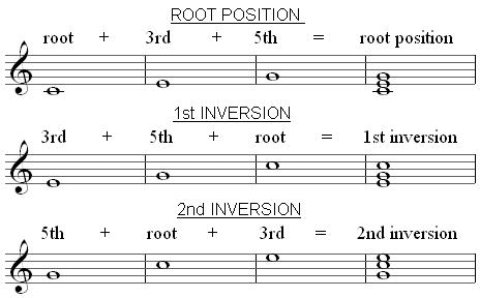
In seventh chords their are inversons. Inversons is a change of intervals, chords or melodies.

There are first inversons where the 3rd is in root position.

Second inverson is when the 5th is in root position.

Third inverson is when the 7th is in root position

When using 7th chords we also use figured bass and lead sheets 

Here shows inversons of chords and the figured bass under them.


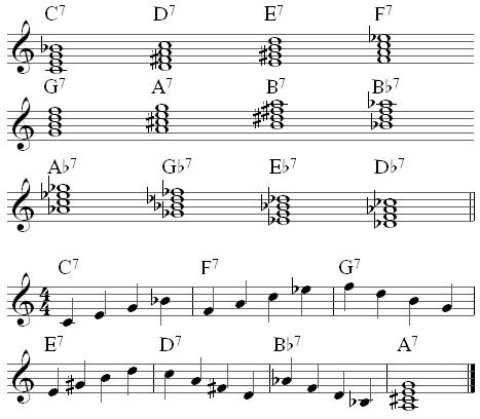
In thos picture are 7th chords and what tpe of chords they are. It also shows the leads.


For those who do not fully get the concept here is a simplier way to figure out the seventh chords adn identifying.


This video helps you to identify the 7th chords and the types of chords.


7th chords

 Seventh 7th chords 

Just like triads there are chords but seventh chords are 4 notes instead of 3. In a seventh chord you had the 7th note of the scale. It is a combination of a traid with an interval of a seventh.

In a seventh chord scale the 5th note is always a dominant chord adn the second note is a hald diminished and the7th note is a fully diminished. 

There are several 7th chords. Major, minor, half diminished, fully diminished and dominant 7th.


Dominant 7th chord are identified by a major traid and a 7th seventh.
Major 7th chord  are a major traid and a major 7th 
Minor 7th chord are minor traid and a minor 7th
Half diminished 7th chord is a diminished 7th and minor 7th
Diminished 7th  chord is a diminished traid and a diminished 7th


Here are ways we identify seventh chords.


Here are seventh chords in inversons and showing you where the root will start.


Here is a basic understanding of seventh chords and how they are played.


This is a video of a musican playing seventh chords on a guitar and showing you with notes make up that chords.


Figured Bass and Lead Sheets

 Figured Bass and Lead Sheets


Figured bass are musical notations that shows you symbols to provide information of the notes. It shows how many intervals are between each notes.

Simple interval are notes that are in the octave and compound intervals are notes is above the octave. 

Figured bass can be shown in different inversons.  There are: first inverson, second inverson and third inverson.

When to find if the notes are inverson you need to note where your root is and find out where your fifth is.

In a chord there is root third fifth and seventh

First inverson is called 6 5 3 where the root moves to the top and the 3rd moves to the bottom.

Second inverson is called 6 4 3 where the 5th is in root position.

Thrid inverson is called 6 4 2 where ther 7th is in the root position.


This teacher is exlpaing the figured bass and how you get them.


  Lead Sheets

Lead sheets are muscial notation that specifies the chords or states what type of chords based on the notes being used. THey can alwasy be shown above the staff or chord.

A way we identify lead sheets are by using Root,Quality and Inverson.
Here is an exapmle of a lead sheet. the A is in the bass clef is in the first space and the reble clef it is in the second space.


This is a video showing you how to read lead sheets music and how you can figure them out.


Triads

 TRIADS 


Triads are three (3) musical notes that are stacked vertically in thirds. These three notes can be seperate by three lines or spaces. There are open chords that play on both staff adn close chords that play on one staff. 

There are different types of traids. The main ones are Major traid, minor traid, augmented traid and diminished traid.

  • To identify a traid we use the line root, third, fifth.
  • In a major traid you have a major 3rd and perfect fifth.
  • In a monior traid you have a minor 3rd and perfect fifth
  • In a augmented traid you have a major third and augmented fifth.
  • In a diminished traid you have a minor third and diminsihed fifth. 


All fifths are perfect except for B to F because it is a diminished 5th. 

In a major scale 1 4 5 is major and 2 3 6 are minor.

In a minor scale 1 4 5 is minor and 2 3 6 are major.

The 7th chord is always diminished.

Watching this video it gives you a detail understanding of traids and broken down concept.


In this video it shows you how traids are being played on an istrument.


Here is me playing a few traid.


Saturday, October 30, 2021

Intervals

 INTERVALS

  • An interval is a distance between two notes or two intervals. There are three types parts of intervals. 
  • There are melodic and harmonic intervals, the distance of the interval, and the quality of the interval.      
  • Tones and semitones are the building blocks for creating intervals. 
  • Compound intervals are intervals that are larger than an octave. 
  • For intervals, there are perfect intervals that can not be major or minor.  


This is a picture of the different types of intervals and how far they are using each semi-tone. It also tells you the minor and minor and perfects.


The picture has 6 different types of intervals. 


The video shows how each interval and its distance. 


The lesson teaches you intervals and explains the different intervals.


Here is a video of me playing the F major in different intervals.


Monday, October 18, 2021

LESSON 4

 Minor Scales

  • There are different types of minor scales 
  • They are Natural minor, Harmonic and Melodic.
  • In the natural minor there are no raised.In harmonic minor the 7th note is raised by a half step and in melodic minor the 6th and 7th note is raised by a half step
  • When finding a relative minor we count down the scale three whole steps and relative major you go up 6whole steps.


This is a picture  by musicnotes showing the different types of minor scales.


This picuture shows an A minor scale


Here is a video by LANDR explaing the what are the minor sclaes.


This is a video by Musictheoryacademy explaing teh different types of minor scales.

LESSON 2

Compound and Simple Meter/Signature


  • Simple time signature is a piece of music that is subdivided up into two part rhythms. Examples: 2/4, 3/4, or 4/4. The top number tells how much each beats gets and the bottom tells us the note value.
  • We identify the meters by the terms duple, triple, and quadruple.
  • Compund time signature are meters in which the beat divides into three, and then further subdivides into six. 
  • Examples of compund time signature would be  6/8, 9/8 and 12/8.


This is a picture of simple time and the different terms and forms.


This is a picture of compund meter and the different time signature and forms.


Here is a video by Music Matters on youtube explaining how you can identify the different type time signatures.


This is a video by musictheoryguy gettung nore advance into each section of simple and compund. This video also explains the difference between somple and compund time. 

This the song I found I am only palyed the two lines and the top part..


This is a video of me playing the song.

Counterpoint to chordal style

 Counterpoint to Chordal Style  In class we mentioned chord harmony. Chord harmony are 3 notes or chords that provides a harmony in the piec...