Friday, September 30, 2022

Embellishing or Non-chord Tones

 Embellishing or Nonchord Tones  

What are non-chord tones? Nonchord tones also known as nonharmonic tones are notes that do not belong in a certain chord. In music, they add a little topping or decoration to bring out the music rather than staying dry and boring.

There are several embellishing chord tones that we use in music. 

Passing Tone (PT) - a passing tone is noted that is approached by steps and continues other going up or down in the same direction by step. There is also accented passing tone that occurs on strong beats.

Neighboring Tone (NT) - a neighboring tone has notes that moves using steps. NT can step up or down but must turn to its original note. If a neighboring tone occurs on the second chord it is called accented neighboring tone and is played on weak beats.

Anticipation (ANT.) an anticipation note is approached by a step and remains the same note. Anticipation are non accented notes. It is basically a note of the second chord played early

Suspension (SUS.) - a suspension note keeps the original note the same and steps downward moving into a next chord. 


In this picture this explains the different types of non chord tones that I mentioned earlier. It shows where each notes goes after being played or after each chord.


Here you can see several more embellishing tones than what I mentioned. In the picture it gives a more dept exploration of how the notes move and which direction they move.


Whiles searching for nonchord tones I came across a video explaining how non chord tones should be certain chord.


Working with chord tones you want to understand the background of what your layering out to have the perfect chord and do not creat any dissonance. 


Wednesday, April 13, 2022

Seventh Chords

 Types of Chords

When ending a music it is called conclusive, but when it does not end it is called inconclusive.  When writing music you must determine wether the music is ending or not 


There are predominant chords, subdominant, and dominant chords. In the scale degree the 2 is considered a predominant chord becasue it comes before the 5th which is the dominant chord. The 4th in the scale is called a sub dominant because it comes just before the dominant and the 6th can be called a tonic because it has 2 notes similar to the tonic. 


The diffrent types of chords and where they are located in the scale. 


This is a next example of what happens in major and minor keys when playing chords. 
In major keys start on the tonic and go to teh predominant whihc can be either 2 or 4 and move to the dominant 5 or 5/ 7 then back to the tonic. 
In minor keys start on tonic but the predominant is a minor 2nd or minor 4th then to a dominant 5 to teh tonic


This video talks about the subdominant chords that is before the dominant chord. Soemtimes teh 4th chord can progress to the 5th or the 1 chord.  Moving to a 4th chord to the tonic is called a plagal cadence in music also known as amen chord. In jazz they use the chord 2 5/7 and 1.


In this video the main chord is the 5 chord. The 7th is usually called the leading tone because it leads to the tone which is one. The 7th is also called a dominant 7th chord.


Cadences

Authentic Cadences 


What are authentic adences in music?

Authentic cadences is a type of progression that uses a dominant to tonic chords to end a pharse of a music.

Authentic cadences are formed when the 5th chords moves to the 1 chord to the end of a musical pharse. 

These are the different examples of the type of authentic. Here you have perfect cadance that starts on the 5th and ends on the 1. Also imperfect authentic cadence thats starts on the 5th chord but first inverson and ends on the minor one. The melody ends on the 3 or 5 on a chord


This video explains to you the predominant and dominant and tonic chords and how you get each authentic cadence.


Voice leading is also a mjaor deal when learning about cadences. When deadling with voice leading which is also coming up with melody for the music or bass notes you need to have an idea of  how much space you need or how far you need to put each notes and chords. Also must neer double notes or over lap them. Overlapping notes means having a E in a tenor and a D in the alto. Also means that you can not have a lover voice higher thatn a upper voice.

When writing music you can use parallel motion and contrary motion. 
Parallel motion is when the upper voices in a music move up and the bass line moves the saem direction as them. 
Contrary motion is when the upper and bass line moves in different directions.


These are the different type of motions that are used in music. 


Lesson 6

 Consonance and dissonance 


Today we started chorale style music which involves the SATB format. SATB stands for soparono, alto, tenor and bass.

Counterpoint are two independent lines that combine together to make a harmony.

Tendency notes are notes with in the key that can be resolve whether from a leading tone or chordal tone in a specific direction 

There are also notes we call conconance and dissonance.

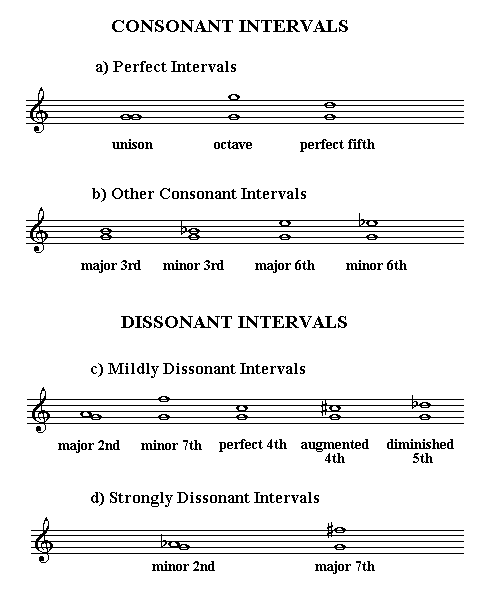
What is dissonance. Dissonace is the sound of two harsh or unstable notes being played the same time when playing chords or intervals and because of the dissonance makes you want to resolve the dissonance into something better or uplifiting. Some examples of dissonance are

The opposite of dissonance is consonance. Consonance notes or intervals are played stably or having a pleasant sound and having a feeling that you don’t need to change to a different chord. When playing consonance, you do not get the feeling of wanting to change that chord because it already sounds perfect. Some examples are major 3rd, perfect 5th, major 6th and others.


Here there is an example of chorale music using the SATB format


Here is where you can see  consonances and dissonance intervals 


To give a better example of how consonance and dissonance intervals are played here is a video from Diana Newton giving you the examples of dissonance and consonance. 


This is a better understanding of what tendeny notes and how they can be resolve.


Wednesday, February 23, 2022

Lesson 3

 Counterpoint part 3


In Lesson 3 were talked about three forms of speciesin music. first, second and third species.
First species ratio form is 1:1 where each note is a whole note through out the cantus firmus. Second Species ratio is 2:1 where each note is a half note or 2 half notes in each bar. Third species ratio is 4:1 where there is each quiater note or beat in each bar. 
When reading or creating a cantus firmus you must always be constance and dissonace. 
Constance is when two notes sound good playing together and dissonance is the clash between two notes making them sound terrible.
In those kinds of music you have passing notes and neighbour. Passing notes are notes that are move stepwise and neighbour notes that move toone chord and comes back to the tonic.
Constance notes are on the accented beat and dissonace is on the unaccented.


This is an example of what a first species music would look like. In each bar there are whole notes.


This is a second species showing the hallf notes. The two half notes make up 4 counts , and with these notes there can even be a suspension when being played.

There are rules we must follow when dealing with a cantus firmus. This video gives a concept of what we should look out for when dealing with second species.


Looking at the music sheet ou can think you understnad what constance and dissonace is but there is mroe things you need to look out for when trying to mkae a cantus firmus. Watching this video helped me a little bit more in identifying those two forms.


Counterpoint 5

 Counterpoint 5

We must not forget what the a counterpoint is. Counterpoint is when two voices or lines are combined together to make a harmony. In lesson 5 for counterpoint we learned about dissoance and chordale music.
Chordale music is a piece of musci taht does not have 2 lines but 4 lines.

Those 4 lines are the alto, soprano, tenor and bass.


Each line has its own notes and melody and harmony.
Constance intervals are played 

and dissonance intervals 

This is a music sheet of what a chordale music would look like.


Watching this video it gives you an idea of how each person should follow along and read what they are suppose to sing.Many tines we just go with the lines that look comfortable to youbut it is not.


By readinga dn understanding how to read those lines we are able to sound constance adn dissonace in the music when we play or sing it. This is  a exaomle of a choir singing using 4 lines and each section taking charge of their lines.


My song to play.


Sunday, February 20, 2022

Counter Point 4

 Counter Point 4

Todays topic was about fourth species in music and suspension.
a ratio to determine fourth species is 4:1 whihc is similar to third species but their difference would be taht fourth has suspernsions and third does not.
A suspension in music is the dissonance that responds or be played to a strong beat in a music.


This picture shows the steps of how to start and end a suspension. It begins with the preparation the starting note whihc should ne constance and then moves on to the suspension whih should be dissonance and then end on the resolution which is constance.

This is an example of fourth species with the sispension on the strong beat.


This is a video showing you the details of what each section of the suspension chord means and what they should sound like when being played.


In the video it shows you the different areas of counterpoint as in fourth species and suspension. It shows the diferent steps of a suspension chord.


( NOT COMPLETED) 

Counterpoint to chordal style

 Counterpoint to Chordal Style  In class we mentioned chord harmony. Chord harmony are 3 notes or chords that provides a harmony in the piec...